
Gray Blending in Fort Myers
Gray blending is a dimensional color technique that weaves highlights, lowlights and gloss through natural gray so regrowth softens instead of forming a line. At Canterbury & Co. Salon in Fort Myers it is a named specialty of the Canterbury Color Team, which specializes in Wella Professionals color and trains under founder Alli Canterbury, herself a former Wella color educator.
There are two ways to color gray hair. You can cover it — and sign up for a root line that returns every three weeks like a bill. Or you can blend it: weave the silver into dimensional color so it reads as intentional brightness, the root line disappears, and the salon sees you when you miss it rather than when the mirror insists.
Reviewed
Blending vs. full coverage, honestly
Full coverage paints an opaque color over every gray strand. It works — until the regrowth arrives as a hard, high-contrast line at the part, which in practice means a touch-up every three to four weeks, forever. Blending takes the opposite bet: instead of hiding the gray, it surrounds it with highlights, lowlights and tone so the silver becomes one thread in a dimensional design. Regrowth then arrives softly, and most blending clients stretch appointments to six to eight weeks or longer. Coverage is still the right answer for some clients — and we will say so when it is yours.
Who blending suits
Three clients, mostly. The one growing out years of coverage who refuses to endure the skunk line — blending makes the in-between stage look deliberate. The low-maintenance client whose diary cannot hold a three-week color cycle. And the client meeting her first grays — or shepherding the last dark strands into full silver — who wants the transition to look like a choice, every week of it. What they share is a preference for hair that looks intentional between appointments, not just on the day of one.
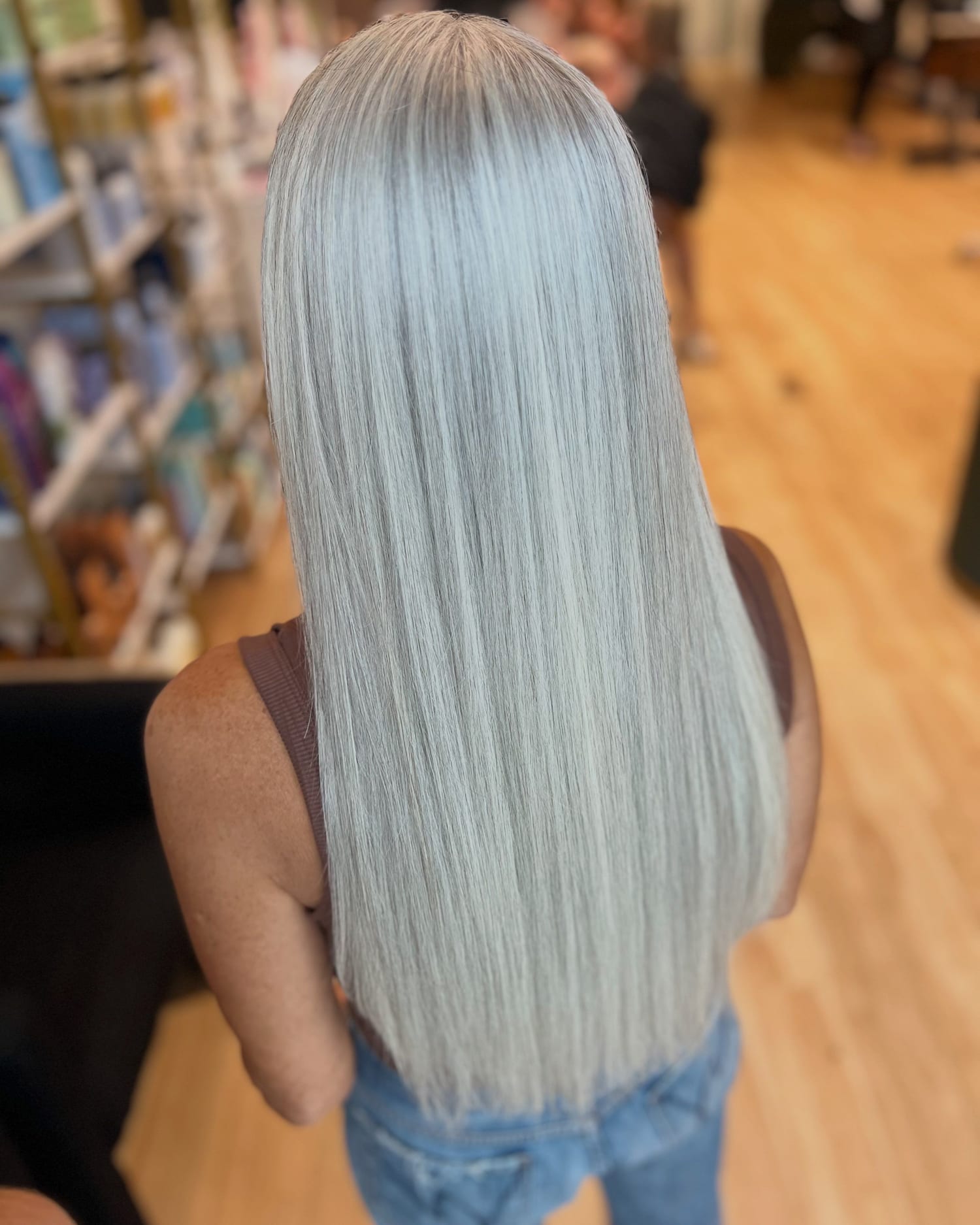

Silver, left exactly as it grew
Not every visit is about color. This is one hundred percent her natural grey, with no color at all: just a Brazilian Blowout, so the silver sits smooth and glossy. Sometimes the most flattering thing a stylist can do for grey is leave the shade alone and look after the texture.
How blending is actually done
“Gray blending” is a goal, reached by a handful of standard techniques used in combination. In plain language, here is what each one contributes — and why the combination is chosen for your head, not from a menu.
Fine highlights, placed where gray grows
The workhorse of blending — sometimes called French blending when the weave is especially fine — is exactly that: very fine highlights placed along the part, the hairline, and wherever your silver concentrates. Lightened pieces sitting beside gray ones make the gray read as brightness, so new growth emerges among friends instead of against a dark backdrop. The finer the weave, the softer the effect.
Lowlights, for depth
Where gray is heavy, the risk is washing out — all light, no dimension. Lowlights weave threads of deeper color back through, restoring the shadow that makes the brighter pieces look expensive. On darker bases the logic reverses: keeping plenty of depth means only a modest amount of lightness is needed to make the silver look deliberate. Depth is what separates blended hair from faded hair.
Gloss and tone, the finishing layer
Gray hair is not one color — it runs from bright silver to steel — and untoned it can drift yellow, especially under Florida sun. A gloss knits the highlights, lowlights and natural gray into one deliberate, shine-finished result: silvery and cool, or warm and champagne, as suits you. It is also the quick appointment that refreshes the whole look between fuller sessions.
Dimensional color is a Wella strength — and ours
Blending succeeds or fails on formulation: the lift of the weave, the depth of the lowlight, and above all the toner that marries them to your natural silver. That is color theory applied precisely — which is rather the house specialty.
Formulated with Wella Professionals
The Canterbury Color Team specializes in Wella Professionals color — dimensional color for the weave and the depth, Shinefinity glosses for the tone that finishes the look. Working deeply in one professional color house means the Color Team knows precisely how each formula behaves on gray hair, which takes color differently than pigmented hair and rewards a colorist who has stopped being surprised by it.
An educator’s standard, taught in-house
Our founder, Alli Canterbury, spent years as a Wella color educator training other salons’ stylists, and our employed stylists work to that standard through a structured career ladder. Blending is judgment work — how fine to weave, where your silver actually grows, when a lowlight will do more than another highlight — and here that judgment is the house method, not a specialty of one chair. Our guide to what makes a great colorist explains what that training looks like from the client’s side of the mirror.
An easy trip from across Lee County — and beyond
Color you trust is worth a drive, and blending rewards the trip more than most services: done well it needs refreshing less often, so the right colorist farther away costs fewer hours a year than the convenient one nearby. You will find us inside Gulf Coast Town Center in Fort Myers, moments from I-75 with free parking at the door — a straightforward run from Estero, Bonita Springs, Cape Coral, San Carlos Park and Naples.
Gray blending questions, answered straight
What is gray hair blending?
Gray hair blending is a dimensional color technique that weaves fine highlights, lowlights and a toning gloss through your natural gray so the silver reads as deliberate brightness rather than regrowth. It is not a single product or formula — placement follows where your gray actually grows, and because there is no solid block of color, regrowth arrives softly and most clients stretch appointments to six to eight weeks or longer.
Which hair salon in Fort Myers specializes in gray blending?
Canterbury & Co. Salon, inside Gulf Coast Town Center on the Fort Myers–Estero line, lists gray blending as a named specialty rather than the skill of one hairdresser. The Canterbury Color Team specializes in Wella Professionals color and trains under founder Alli Canterbury, a former Wella Professionals color educator, and the salon holds 4.9 stars across 174 Google reviews as of October 2026.
How long does it take to grow out gray with blending?
Hair grows roughly half an inch a month, so a full transition to natural silver is honestly measured in months to a couple of years depending on your length. What blending changes is how those months look: instead of a hard line creeping down from the part, the gray is woven into deliberate dimension, so every stage of the grow-out reads as a finished color. You look done the whole way through — that is the point.
How often will I need appointments with gray blending?
Most blending clients settle into a rhythm of roughly six to eight weeks or longer, compared with the three-to-four-week treadmill that full gray coverage demands. Because there is no solid block of color to betray a root line, regrowth arrives softly. Many clients stretch further still with a quick gloss between fuller appointments, and your stylist will map the honest rhythm for your hair and your percentage of gray in consultation.
Does gray blending work on dark hair?
Yes — and dark hair is where blending earns its keep, because silver against espresso is the highest-contrast case and a hard line shows fastest. The approach is usually dimensional: fine highlights and lowlights woven through so the gray reads as intentional brightness rather than regrowth. Dark bases sometimes need a staged plan to get there healthily, and we will tell you plainly what one appointment can and cannot do.
What is the difference between gray blending and highlights?
The technique overlaps; the intent differs. Highlights brighten hair for brightness’s own sake. Gray blending uses highlights, lowlights and toning specifically to marry your gray into the rest of your hair — placement follows where your silver actually grows, and the toner is chosen so the gray becomes part of the design. It is highlighting with a strategy, which is why the consultation matters more than the menu word.
Is gray blending cheaper to maintain than full coverage?
Generally the economics favor blending over time, for a simple reason: fewer chairs. Full coverage books every three to four weeks because the root line demands it; blending stretches to six to eight weeks or beyond, often with only a gloss in between. Individual appointments vary with the work involved, which is why we quote in consultation — but the pattern of fewer, softer appointments is the honest maintenance story.
Start with a consultation
Book online and your appointment begins with an unhurried consultation — your percentage of gray, where it grows, the maintenance rhythm you can actually live with, and your quote before any color is mixed. Blending sits within our wider color services. If you are still deciding, we have written honestly about what gray blending actually is, how to grow it out without the awkward stage, how it works on brunette hair, and when full coverage is still the better call, or browse the journal for more on color in the Florida sun.